Cover Article | By Jocklyn Mundy | Photos courtesy of Windermere Photography and the Nabers Family
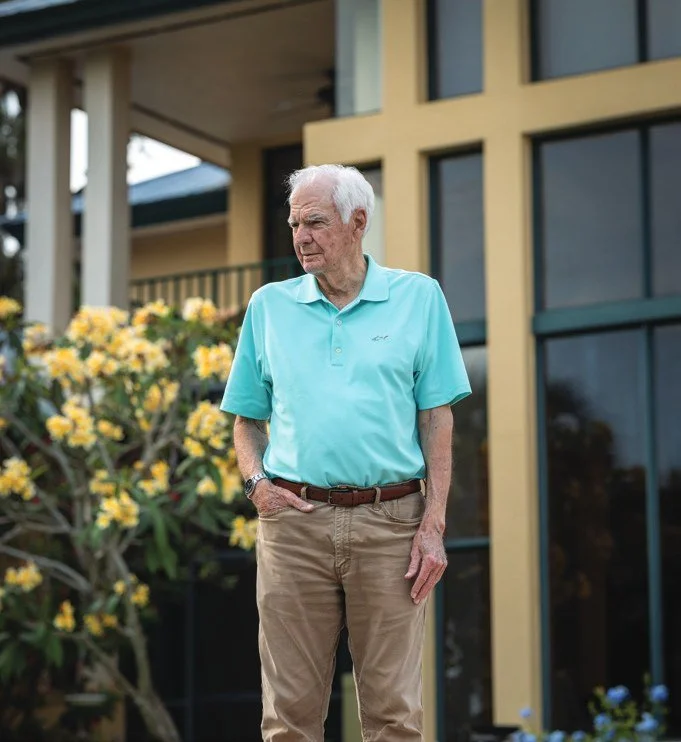
John Mills Nabers' memories of growing up in Windermere are ones he treasures deeply. Like most boys of his era, he spent his days exploring the woods, climbing trees, and fishing along the lake shores—almost always barefoot. “I learned very quickly the summertime temperature of sand in the full sun—on bare feet,” he laughs.
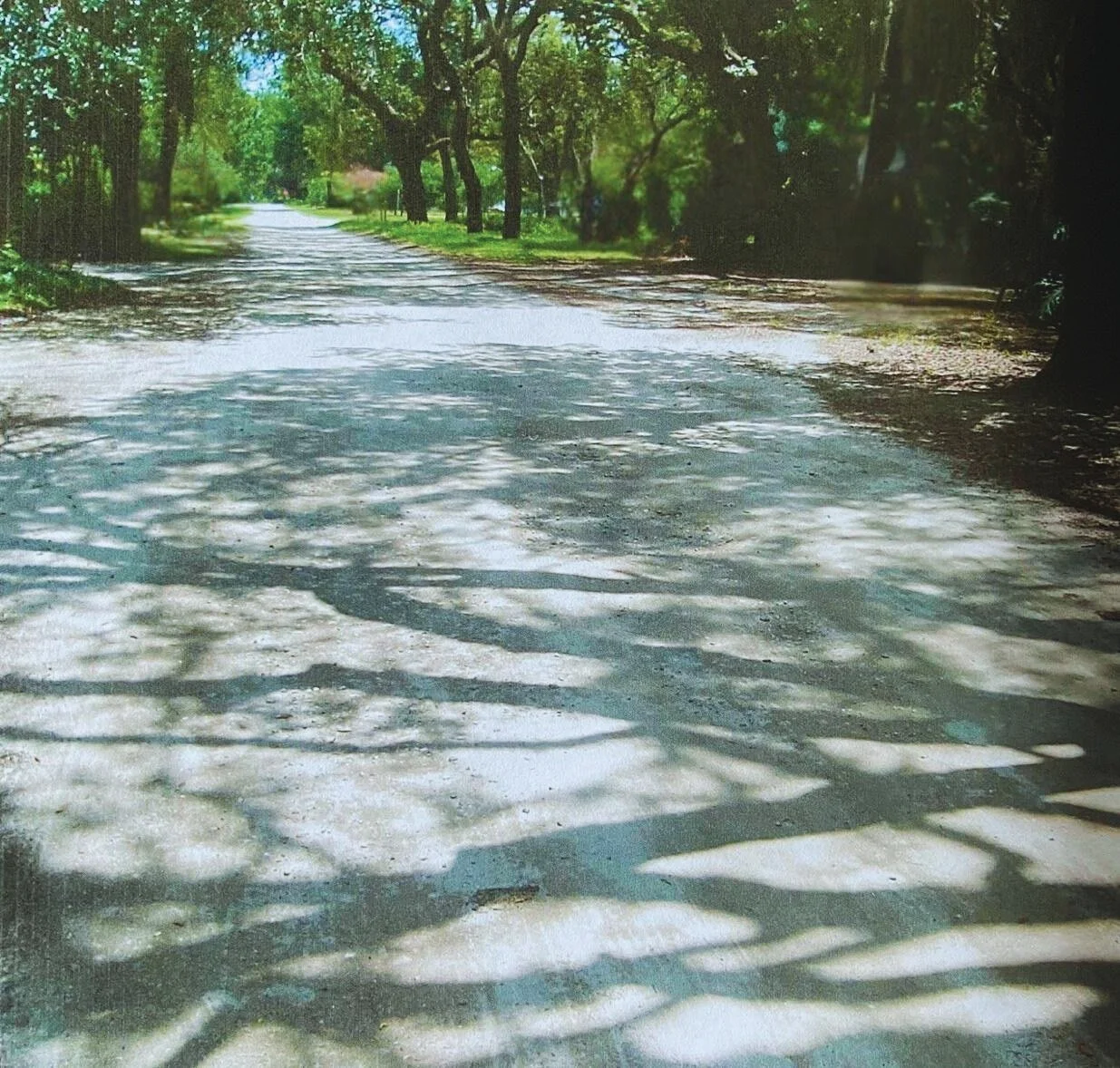
He would navigate the now-iconic Windermere sand roads by sticking to the shaded parts and avoiding the rest. He says, “I have vivid memories of the look and feel of the streets in the summertime.” The dappled shadows cast by the oaks lining the road weren’t just cooler underfoot—they formed a beautiful pattern of light and dark.
As the years have passed, those shadows have come to mean something more: four generations of family who have walked those same sandy streets, cherished their quiet beauty, and called Windermere home.
A Modest Beginning
In the summer of 1943, Albert and Lucinda Nabers arrived in Windermere with their five-year-old son, John Mills. A few months earlier, they had moved to Central Florida to be closer to family in Winter Garden, following Al’s early retirement due to medical reasons. An avid fisherman, Al was quickly drawn to the area's natural beauty, especially the Butler Chain of Lakes. The decision came easily when they found a home on Oakdale Street with half an acre of orange trees.
The Nabers did not imagine that modest start would lead to a lifelong bond and four generations calling Windermere home. For young John, the town was far more than just a new address. He recalls, “After living in Atlanta, where I was born, Windermere was a completely different world.” The white sand roads all seemed to dead-end at a lake, each inviting a line to be cast. There were oaks to climb, tracts of land to explore, and the sweet scent of orange blossoms in the spring signaled that the tasty fruit would soon follow. His days quickly took on the rhythm of what he describes as a “Tom Sawyer existence.”
A Small Town Childhood
Windermere in the 1940s was a town still settling into itself, less than a couple of decades past incorporation, and fewer than 200 residents. Homes were modest, yards were spacious, and the community was small enough that little went unnoticed.
John began first grade shortly after arriving. By then, Windermere had already outgrown its original one-room schoolhouse. The two-room school served all six grades, with three grades per room, and some classes comprised just a handful of students. “There were no buses or after-school clubs,” John recalls. “You could hear what the teacher was discussing with the higher grades, and I think that helped the progress academically.” John and the other students moved outside Windermere after elementary school to Orlando. No school buses were provided from Windermere to Orlando, so kids had to carpool. John remembers, “Families did not have two vehicles, and the city buses only went as far as Gotha at the time.” John attended junior high school in Orlando at Memorial on Lake Eola and graduated from Edgewater downtown.
Outside the classroom, the town itself was part of the education. There was always something to do—swimming, fishing, exploring, hunting. Windermere didn’t need playgrounds or programs for a boy with energy and curiosity. It offered space, freedom, and the kind of independence few children experience today.
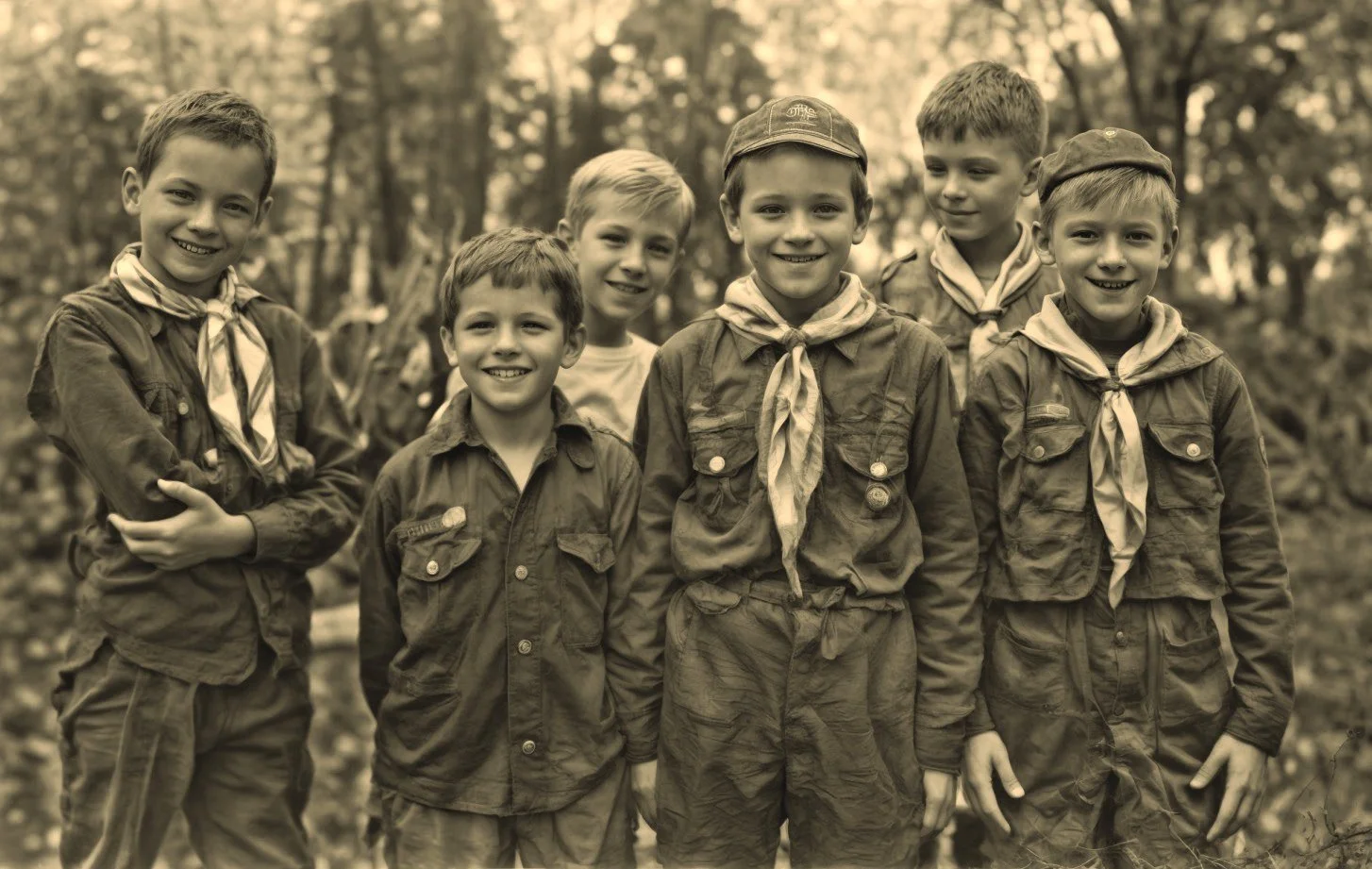
The Cub Scout Pack of Troop 223, circa 1943 to 1947, included, left to right, back: Ray Duncan and Whit Chase; front: John Nabers, Donnie Abele, Bobby Mitchell, and Kenneth Groover. The image was enhanced.
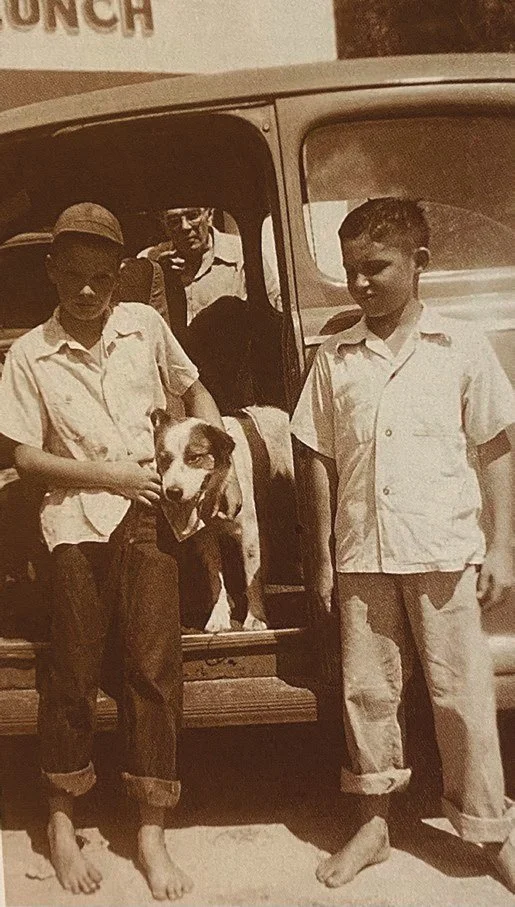
John with his dog Butch and Bobby Mitchell
As school taught structure, Windermere’s church and civic club taught connection. In a small town with no movie theaters or organized youth leagues, these two places served as the social anchors of community life.
Sundays were full and meaningful. Mornings brought families together at the Union Church for Sunday school and worship. Lucy Nabers, who had studied piano at Brenau College, played for the Sunday school classes and occasionally filled in on organ for the main service when needed. Evenings were set aside for youth gatherings, often held in familiar spots like the church hall or Reverend Ishay’s boathouse. There, kids listened to missionary stories and watched travel slides.
The Community Club, now known as Town Hall, was where Windermere came together. Potluck dinners filled the space with conversation, casseroles, and homemade pies. RSVPs weren’t necessary; you just showed up and always left full. Cake walks were a regular highlight, and on special nights, with a projector and a reel, the club transformed into a movie theater, showing fishing films, travelogues, or even an Abbott and Costello comedy. John recalls, “We even had a magician perform, who escaped from a straitjacket as his final act.”
It was a rhythm built on people and presence. There were no tickets, no stage lights, just the steady heartbeat of a small town.
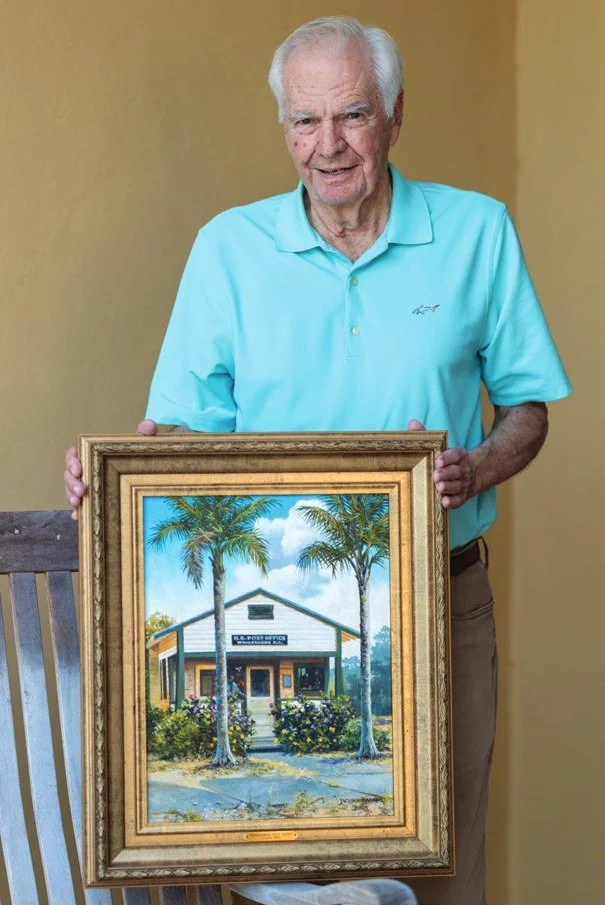
John holding “Windermere Post Office”
A Town Remembered: The Lost Landmarks of Windermere
Some memories are too meaningful to leave behind. Wanting to preserve the Windermere of his childhood, John Nabers commissioned a series of oil paintings from renowned Florida artist Jackson Walker. Executed in a traditional realist style, each canvas depicts a building that once stood in the heart of Windermere. The only building depicted that remains today is the Windermere Union Church, now The Family Church Chapel.
Each painting is a window into a quieter Windermere. Through these artworks, John Nabers has offered the community a rare opportunity to revisit its past, captured in oil with thoughtfulness and historical detail.
In celebration of Windermere’s Centennial, this collection will be on public display throughout the year in the lobby of the Windermere Administration Building.
A Nation At War
While Windermere offered a peaceful rhythm, the world beyond its lakes was in turmoil, deep in the throes of the Second World War. Nearly every family in Windermere had someone in uniform or knew someone who did. John recalls that food and gas were rationed, schools collected materials for the war effort—including scrap metal—and children saved Liberty Stamps to help buy military supplies. Factories nationwide halted production of cars and everyday goods, redirecting their machines to manufacture tanks, jeeps, and airplanes. People kept their old cars running, patched their clothes, and made do with what they had. Newsreels at the movies kept the public informed with footage from the front lines.
John remembers swimming in Lake Bessie one afternoon when the church bells suddenly began to ring. Startled, he ran home to find his mother. “The war is over,” she told him, her voice filled with relief and joy. The sound of those bells—and the feeling that followed—has stayed with John ever since. What left the deepest impression wasn’t just the celebration, but the overwhelming sense of unity—a country that sacrificed, supported, and stood together for something bigger than itself.
Beyond the Lakeshore
After high school, John continued his education at the University of Florida. Two years in, he enlisted in the Air Force Reserve and served six months of active duty before returning to graduate in 1960. He then joined Florida National Bank of Orlando—just in time to be recalled to active duty when President Kennedy responded to the Berlin Wall crisis. Following another year of service, John returned to the bank, where he would build a career that spanned decades. Over time, the bank changed names, from Florida National to Sun Bank to SunTrust, but John remained, eventually retiring as senior vice president and chief credit officer.
While working at the bank, John met Patricia May Cade, a native of London, England, who had come to America with a friend, with dreams of reaching the West Coast. But to John’s good fortune, they ran out of money halfway through their journey and took ‘temporary’ jobs in Orlando. That “temporary” stop became permanent after Patricia met John. Together, they raised two children, Kerry Louise and John Cade, and built their home on Highland Avenue not far from the Oakdale Street house where John’s childhood began and his mother still lived.
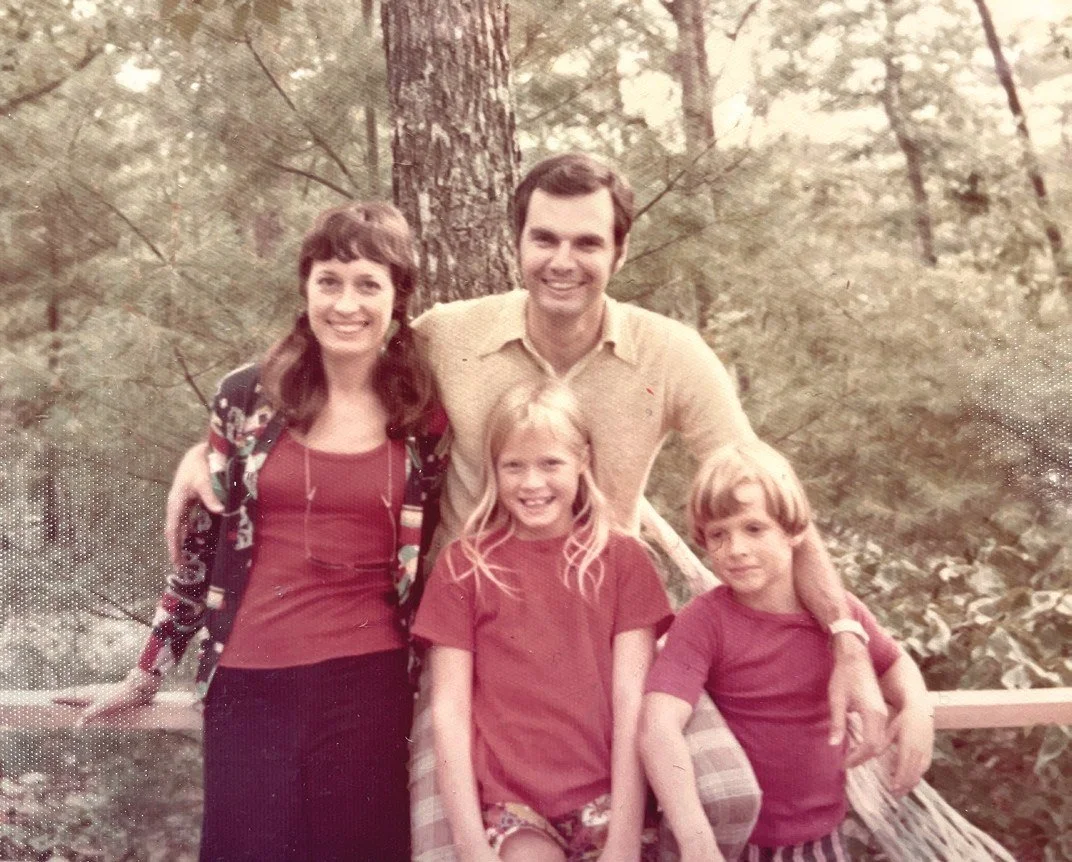
Pat, John, Kerry, and Cade
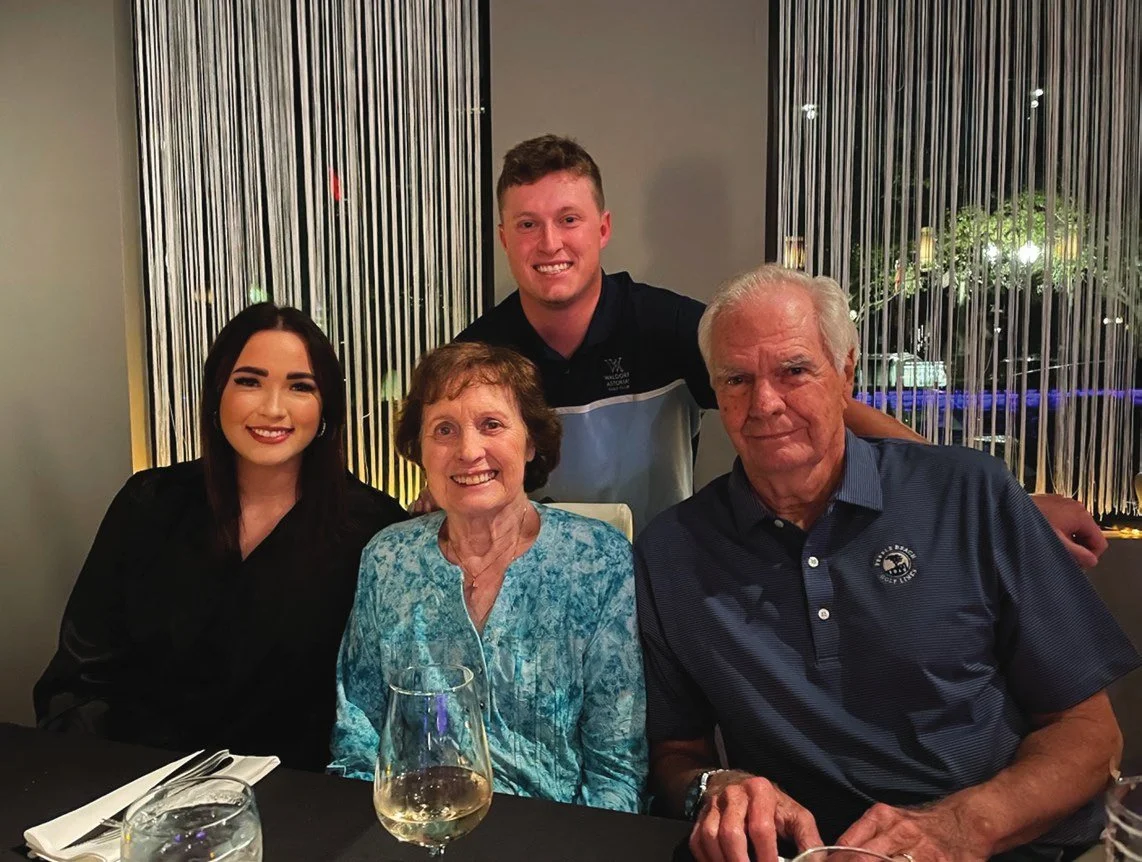
Pat and John enjoying time with their Grandchildren, Emily and Matthew
As the years passed, John endured profound losses. When he was 13, his father, Al, passed away from long-term health complications after being mustard-gassed during World War I. Later, the family faced the heartbreaking loss of John and Pat’s son, John Cade, who passed away at 20 due to a medical condition. In time, John would also say goodbye to his mother and his bride Pat. He knows that no amount of time with loved ones is ever enough, but the memories and the bonds built over a lifetime remain.
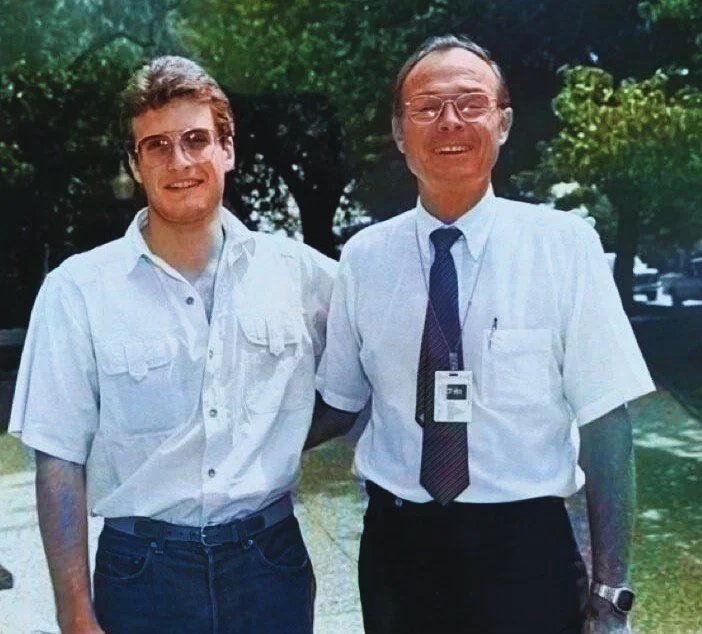
Cade Nabers pictured with former Windermere resident Dr. Freeman Cary, a close family friend, U.S. Navy admiral, and attending physician to Congress. With Dr. Cary’s endorsement, Cade served as a United States Senate Page in 1985.
John still resides in the home he and Pat built on Highland Avenue, overlooking Lake Bessie. Their daughter Kerry and her husband, David Sharpe, also raised their family in Windermere on Oakdale Street, just down the shoreline. Grandson Matthew now lives in Winter Garden, and Granddaughter Emily is the fourth generation to call Oakdale Street home—and the third to live in the house that first brought Al and Lucy to Windermere.
John’s commitment to service extended well beyond his career. He gave time and energy to the Town Council, the Kiwanis Club, the Jaycees, the March of Dimes, Junior Achievement, United Way, and Friends of Lake Apopka. He most recently served as president of the Central Florida Kidney Center.
Legacy in Bronze
John has served Windermere in many ways, through civic leadership, quiet generosity, and a deep love for the town’s character. But perhaps his most visible contributions are the bronze sculptures John commissioned, which now live at the heart of town life, inviting pause, reflection, and delight from all who pass by.
Outside the Windermere Library, a young boy lies stretched on his stomach, nose buried in a book. The sculpture, titled Summertime Read, was created by Florida artist W. Stanley Proctor and has been a fixture since 2005. Look closely, and you’ll see delightful details. The boy is reading Harry Potter, and the lines on the open page can be clearly read. It’s more than art; it’s an invitation. Children often stop to touch the pages, parents pause for photos, and longtime residents recognize the spirit of curiosity that has always defined Windermere in that quiet reader.
In 2021, John gifted the town another bronze sculpture, Golden Games, also by Proctor, which was installed just beyond the picnic pavilion in Central Park. The sculpture captures a boy mid-throw, and a golden retriever ready to take off in pursuit. It’s a moment frozen in time, playful and familiar. On any given day, visitors can be seen smiling as they pass, kids pointing mid-game, families using it as a meeting spot or a backdrop for photos. It fits naturally into the park, like it was always meant to be there.
These sculptures aren’t just decorations; they are landmarks. They reflect John's values: learning, play, and a deep love for the place that raised him. In commissioning and donating them, he offered Windermere something lasting to be enjoyed for generations, a timeless gift from the heart. But more than any sculpture, John’s legacy lives in the lives he’s touched and the community that has shaped him just as much as he has helped shape it across generations.
John knew Windermere when there were more orange trees than houses and people combined. Decades before it sat in the shadow of Cinderella’s Castle, it was a quiet lakeside town where kids spent their days chasing bass, climbing oaks, and exploring trails that began at their back door. So much of what made Windermere special then still lingers today: the imprint of footsteps on sandy streets, neighbors who don’t hesitate to lend a hand, and the simple joy of watching the sunset from the end of a dock. The town has grown, but its spirit remains. And the dream of Windermere, which John discovered as a five-year-old boy, remains alive in the town that helped raise him.
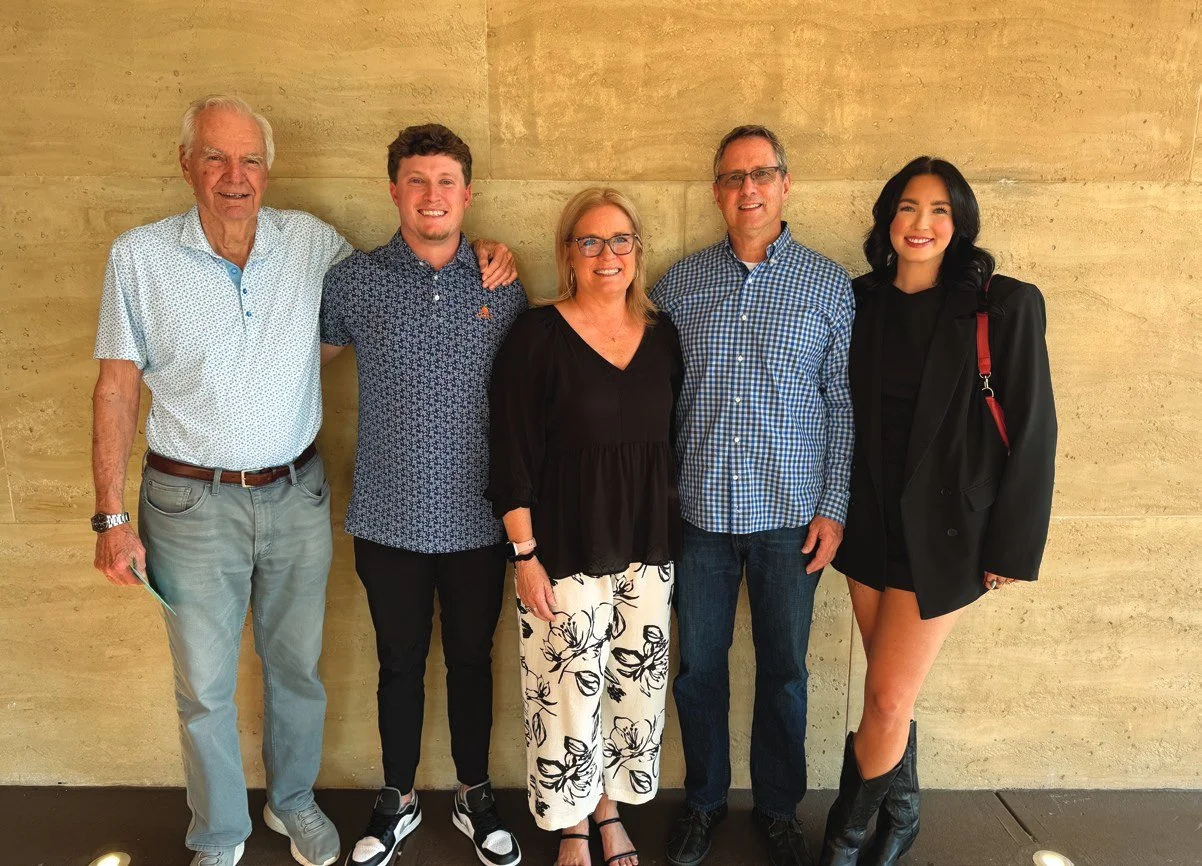
John Nabers, Matthew, Kerry, David and Emily Sharpe
“Penmanship, Posture, and Patriotism”
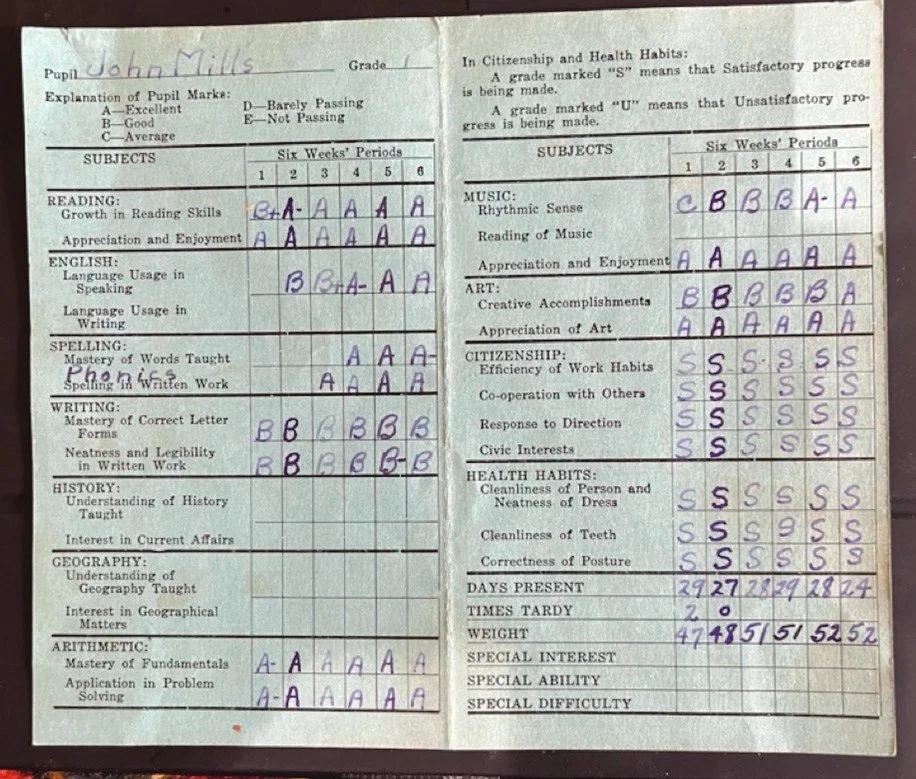
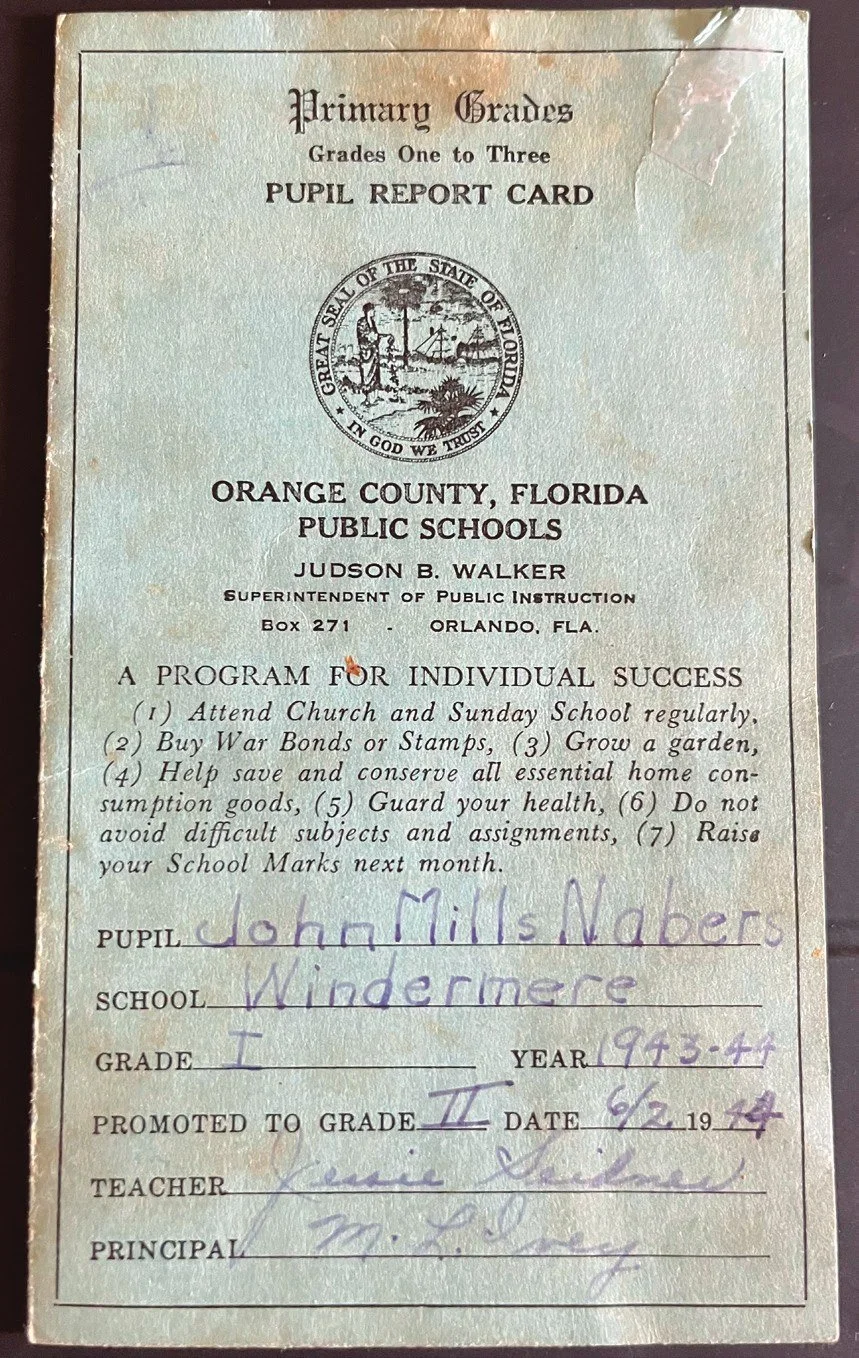
In 1943, kindergarten was not yet part of the standard school pathway. So at just five years old, John Mills entered first grade at Windermere Grade School, a two-room schoolhouse. His report card reflects his early progress in reading, writing, and arithmetic fundamentals, as well as the era’s values, including church attendance, posture, citizenship, and even growing a victory garden to support the war effort.